OPTIMAL
a film by Kijun Seo
The film
One story, told by a narrator in four parts. In 1962 two mathematicians described a procedure that ends in a “stable” world, where no two people would rather break away together; they called it make-believe. The film follows an island that tried to live inside that dream: an orchid crossed for the nation, and people sorted by the state; ten thousand dollars for a child, and ten thousand dollars not to have one; a flat applied for like a proposal, on ground made of sand that its neighbours, one by one, stopped selling; a dating service for public officers, and, in the same years, a larger pool tested every six months so that its women do not become pregnant. It ends in the hawker centres. The state moved 18,000 street hawkers indoors; strangers sat at one table and made a language for coffee; then the rooms went into the network, the diners were taught to return their trays, and the state began to pair retiring hawkers with successors. One stall at Maxwell, on the street since 1942, looked for a successor and found none. The last matches are the ones nobody arranged.
- Every document read or shown is quoted verbatim, and each quote was checked against its source. The narration was written for the film: the links it draws between facts are the film’s, and every fact in it is sourced.
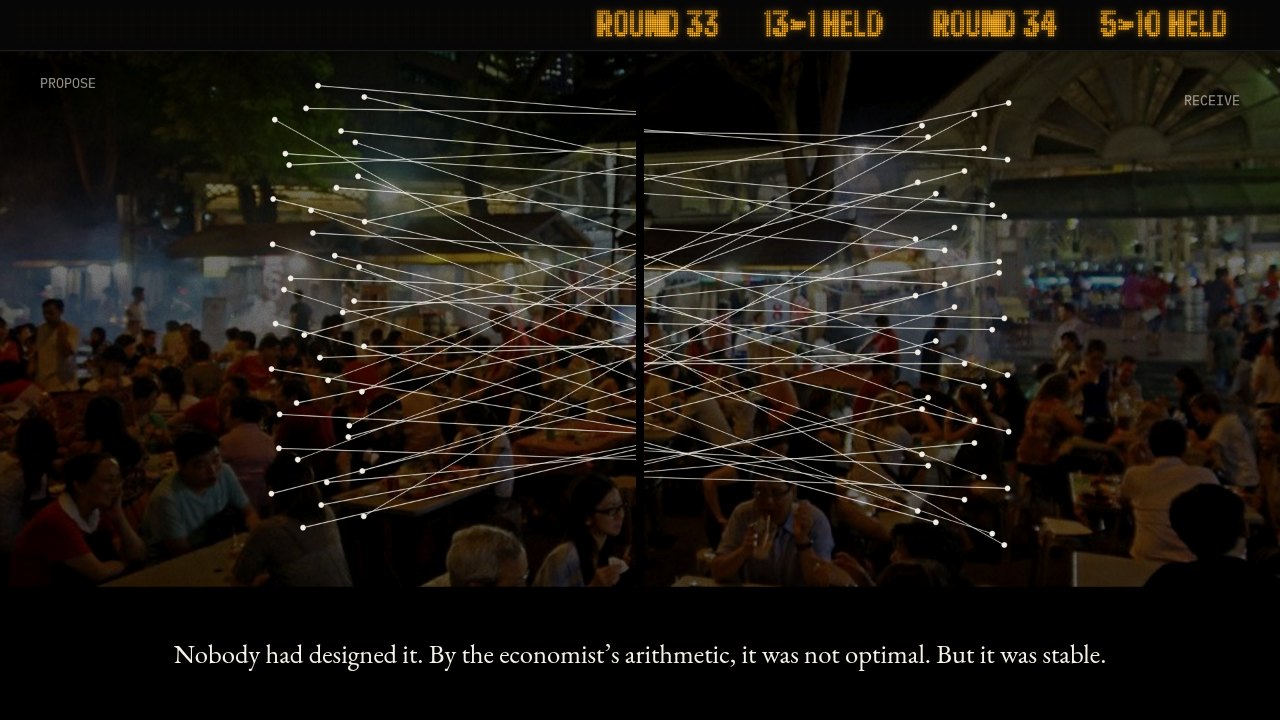
- The drawings are computed in your browser. The Gale–Shapley run is real: 40 proposers and 40 receivers with random preferences (seed 1962). The LED ticker over the frame is that run’s own log.
- The faces in the strings, and Sarah, Daniel, Alex and the selfie, were generated for the film with StyleGAN2, trained on FFHQ. None is a real person. No generated face stands for a migrant worker: the second pool is shown only in real photographs, or as dots.
- All voices are synthetic (ElevenLabs Eleven v4), each designed from a written description. None is cloned from, or modelled on, any real person, broadcaster or filmmaker, or the people quoted. The music was made for the film; the karaoke song was generated with ElevenLabs Music.
- The Maxwell Food Centre board is drawn from OpenStreetMap: its building and 101 of its stalls, each at its mapped position with its unit number (© OpenStreetMap contributors, ODbL; surveyed 2025). The diners, tables, trays and the cursor are a model run in your browser; the counters over it carry the national figures, with their sources.
- The footage and photographs are openly licensed; the list below gives each one.
Data: live births, SingStat M810091. Satellite: Landsat (USGS/NASA, public domain).
Licences: several pictures are CC BY-SA, and their share-alike terms may extend to the film; the list below gives each one.
Typefaces: EB Garamond, Archivo Narrow, Archivo Black, IBM Plex Mono, Anton, Big Shoulders and Major Mono Display (SIL Open Font License); WenQuanYi Zen Hei (GPL, with its font exception).
Documents
In the order they first appear. Select a timecode to go there.